Human-Centric Robotics: Shaping the Next Era of Smart Factories

The factory floor has always been a study of contrasts – people relying on machines, and machines relying on people. For decades, automation mostly sat on one side of that line: big robots in fenced-off cells, programmed for speed and volume.
But the way factories operate today is changing. Product variants are rising, labour availability is shrinking, and expectations for quality, traceability, and safety are higher than ever. Manufacturers across Europe, India, and the U.S. are confronting the same truth:
Rigid automation isn’t enough anymore.
Flexible, human-centric automation is.
This shift is transforming the foundation of the smart factory. Not by replacing workers, but by designing systems around them. Robots are becoming collaborators, workflows are evolving, and digital tools are helping humans make faster, better decisions.
Human-centric robotics isn’t a trend.
It’s the next phase of industrial competitiveness.
Why Human-Centric Robotics Is Rising Now
Traditional automation delivered incredible value – especially for high-volume production. But as manufacturers navigate labour shortages, increasing product complexity, and fluctuating demand, the limitations of old models become clear.
Across industries, three forces are accelerating human-centric robotics:
1. Labour Gaps Are a Global Reality
Skilled operators are harder to find – and hard to retain. In the EU and U.S., vacancies in maintenance and machine operation roles have become a major constraint on output. Cobots and assistive robots offer a scalable solution without overhauling entire lines.
2. Flexibility Is Beating Raw Throughput
A line that switches from one product to another seamlessly often outperforms a “fast but rigid” system. Human-robot teams can adapt to variability significantly better than traditional automation alone.
3. Industry 5.0 Is Setting the Direction
The European Commission frames Industry 5.0 around three pillars:
- Human-centricity
- Sustainability
- Resilience
Source: European Commission on Industry 5.0 (research-and-innovation.ec.europa.eu)
This isn’t about “taking humans out.”
It’s about amplifying human capability with better tools.
What Human-Centric Robotics Actually Means
Many assume it only refers to cobots – but the reality is broader and more strategic.
1. Collaborative Workspaces Designed for Safety & Flow
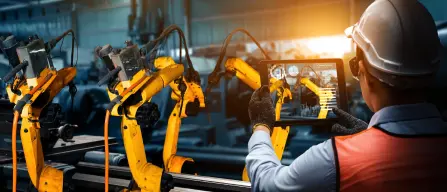
Robots with force-limiting joints, vision-based safety, and proximity detection now work directly beside operators.
This isn’t just safer – it creates new kinds of workflows: human judgment + robotic consistency.
Research in manufacturing safety shows that structured human-robot interaction reduces ergonomic injuries and improves task quality.
Source: Cognitive Robotics – Safety & Interaction Study (keaipublishing.com)
2. Intuitive Control Interfaces Anyone Can Use
Modern robots no longer require coding specialists.
Operators can teach tasks via:
- Hand-guiding
- Low-code HMIs
- Visual programming
- AR-based training
This democratizes automation – making it maintainable, not intimidating.
3. Digital Twins That Simulate the Team, Not Just the Robot
Digital twins used to model only the machine. Now they model:
- Human movement
- Ergonomics
- Task allocation
- Safety zones
- Robot behaviour under variability
A study on digital human modelling demonstrates how simulations reduce layout errors and improve interaction design.
Source: Digital Human–Robot Simulation Review (pmc.ncbi.nlm.nih.gov)
4. Robotics That Improve Worker Well-Being
This is one of the most overlooked dimensions:
When robots remove repetitive strain, hot areas, heavy lifting, or awkward angles – workers experience better long-term health and job satisfaction.
And factories benefit: fewer injuries, fewer stoppages, fewer quality dips.
What Manufacturers Actually Gain
A human-centric robotics setup isn’t “soft.”
It’s a more resilient business model.
1. Faster Adaptation to Variants
Humans excel at identification, judgment, and correction. Robots excel at precision and consistency. Together, they adapt far quicker during new product introductions or variant manufacturing.
2. More Predictable Quality
Robots perform the steady, repetitive tasks; humans handle nuance.
The result: more stable first-pass yield, fewer reworks, clearer traceability.
3. Lower Operational Risk
Human-centric robotics reduces both:
- labour-related downtime (absenteeism, fatigue, turnover)
- machine-related downtime (because humans can intervene earlier)
4. Better Use of Skilled Labour
A technician with robotic support can manage more stations.
An operator can oversee multiple assisted tasks.
A supervisor can make decisions with clearer data.
This multiplier effect matters in every geography facing talent scarcity.
5. Strong Sustainability Outcomes
Because workers and machines interact more efficiently:
- scrap reduces
- energy use per good part decreases
- material handling waste drops
Industry 5.0 positions sustainability not as a constraint, but as an outcome of better systems.
Challenges – And How Leading Factories Overcome Them
1. Poor Task Selection
Not every job should be collaborative.
Manufacturers succeed when they begin with:
- repetitive tasks
- ergonomic risks
- quality-critical actions
- high variation tasks where human oversight matters
2. Workspace Redesign
Mixing humans and robots requires thoughtful cell design:
Safety first
Visibility second
Ergonomics third
Output last
3. Training & Culture
Operators need confidence – not just instruction.
Communication matters as much as integration.
4. Scaling Beyond the Pilot
Most factories set up one “demo cobot cell” and stop there.
Human-centric robotics only delivers value when it spreads across the line, not when it lives as a showcase.
A Practical Example
A mid-size European automotive supplier introduced a collaborative robot to assist with part alignment and torque-critical fastenings. The robot handled force-dependent steps, while the operator monitored positioning and verified assembly.
Measured over six months:
- ergonomic strain complaints decreased
- changeover time improved due to operator-driven adjustments
- defect rates dropped because alignment was consistent
- operator satisfaction increased due to reduced fatigue
No magic. No overnight transformation.
Just better design around people – and measurable outcomes for the factory.
The Direction Smart Factories Are Moving
Factories that adopt human-centric robotics will gradually look different from traditional automated lines:
More responsive.
Because humans can still intervene intelligently.
More modular.
Because automation adapts to the worker, not the other way around.
More sustainable.
Because precision + human oversight reduces waste.
More resilient.
Because human-robot systems handle variability better than fixed automation.
More competitive.
Because the workforce feels valued, upskilled, and engaged – reducing turnover and improving long-term stability.
Conclusion
Human-centric robotics is reshaping the next generation of smart factories – not by replacing the human workforce, but by elevating it. By blending human adaptability with machine precision, manufacturers gain flexibility, higher quality, lower risk, and better long-term resilience.
The factories leading this shift are proving a simple truth:The smartest automation isn’t the one that removes people –
it’s the one that helps them do their best work.